
Seasonal Vehicle Shipping To and From Arizona
Arizona's winter population brings a predictable rhythm to vehicle transport.
Arizona's winter population brings a predictable rhythm to vehicle transport. Southbound demand climbs in the autumn and northbound demand climbs in the spring, and booking around those swings is the single most useful thing a seasonal traveler can do.
Speedy Car Logistics Glendale coordinates seasonal vehicle shipping rather than pretending every truck on the road is our own. That distinction is worth stating plainly: our job is planning the shipment, selecting equipment appropriate to the vehicle, keeping communication clear, and making sure the paperwork and handoffs happen properly at both ends of the trip.
Load positioning affects more than convenience. Heavier vehicles generally sit low and toward the axles, taller vehicles avoid the top deck where clearance is tight, and vehicles dropping first sit where they can be removed without unloading everything else. It is a small logistics puzzle solved before the truck leaves.
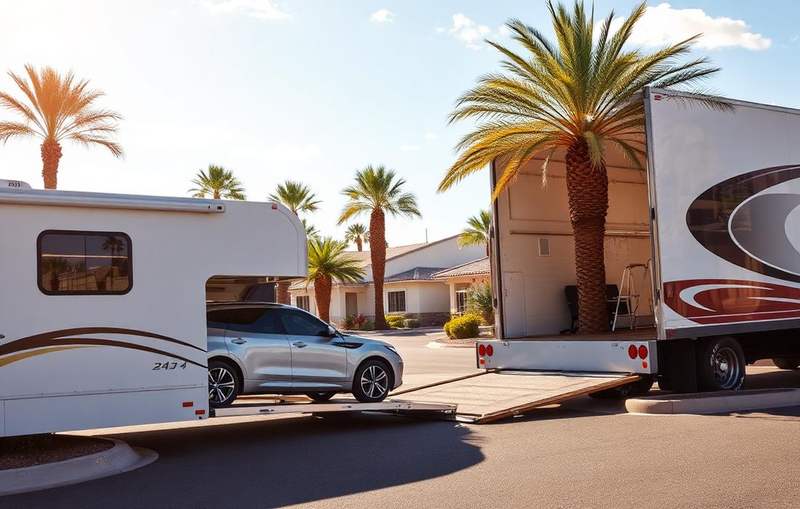
Key Considerations
- Autumn southbound and spring northbound demand patterns
- Earlier booking during peak seasonal windows
- Storage and prep advice for vehicles left in the heat
- Battery, tire pressure and fuel stabilizer guidance
- Repeat scheduling for returning seasonal customers
There is no rule that says a valuable car must ship enclosed or that a modest car cannot. The practical questions are whether the finish is difficult or expensive to correct, whether the vehicle is irreplaceable, and whether the owner would be comfortable with the same exposure the car would face on a highway drive.
Whichever you choose, the securement standards are the same in principle: the vehicle is held by the wheels or rated frame points, checked at intervals, and documented before and after. The difference is the environment it travels through, not the care taken to keep it in place.
For customers who are genuinely undecided, a useful test is to imagine the vehicle arriving with a normal amount of road grime and a small stone chip. If that would be a minor inconvenience, open transport is fine. If it would be a problem worth paying to avoid, enclosed is the right call.
Preparation and Handling
Disable alarms, or supply clear instructions for switching them off. An alarm sounding for hours on a moving trailer is a genuine problem, and a driver who cannot silence it has few options. Remove or deactivate toll transponders too, so no charges accumulate while the vehicle is on a truck.
Have your keys ready. Most carriers want one working key for the ignition and doors; keep your spare. If the vehicle needs a specific procedure to move in and out of transport mode, write it on a card and leave it with the driver.
Photograph the vehicle thoroughly in daylight. Take wide shots of each side, then closer images of the bumpers, wheels, mirrors, roof and any existing imperfection. Photograph the odometer and the fuel gauge as well. The whole exercise takes ten minutes and gives you a dated record that is entirely your own.
Fold in the mirrors, remove roof racks, bike carriers, spoilers and any loose exterior accessory. Anything that can be removed easily should be, both to prevent damage and because protruding accessories can affect how the vehicle fits in its assigned position on the deck.
Request a Quote
Call (602) 844-1826 or send your vehicle and route details.
Pickup, Transit and Delivery
Keep the loading area clear. Move other vehicles off the street where you can, make sure the driver has room to lower ramps, and be mindful that loading needs daylight or good lighting to be done properly and documented accurately.
Plan to spend fifteen to thirty minutes at pickup. You and the driver walk the vehicle together, note its condition on the bill of lading, agree on what is recorded, and then the vehicle is loaded and secured. Read the condition notes before signing rather than after.
Someone must be present at pickup, but it does not have to be you. A spouse, neighbour, colleague or friend can release the vehicle as long as they are authorised, have the keys and understand that their signature records the condition. Tell us who it will be in advance.
Federal hours-of-service limits cap how far a driver can travel in a day. That is the mechanical reason a cross-country trip cannot be compressed, and the reason honest companies quote a window instead of a date. A carrier who is required to stop will stop.
Nothing about transit requires you to do anything except stay reachable. The most common cause of a delayed delivery is a customer who cannot be contacted when the driver enters the destination area.
If your timing is tight, tell us at the start rather than after booking. Some lanes can be planned around a firm date with enough notice; others cannot. Knowing which is which before you commit is far more useful than discovering it later.
Delivery access follows the same logic as pickup. If the destination street cannot take a full-size carrier, agree on a nearby lot ahead of time rather than discovering the problem while the truck is idling in traffic.
Inspect in good light and take your time. Walk all four sides, check the roof, look at the wheels and lower panels, and compare what you see with your own photographs. If it is dark or raining, use a flashlight and note on the paperwork that conditions limited the inspection.
Cost Factors
Be cautious with a quote that sits far below everything else you have seen. Auto transport is a competitive market with visible costs, and a number well under the going rate often means the shipment will sit unassigned until the price is revised upward. A realistic quote that moves on schedule is worth more than an optimistic one that does not.
Flexibility is genuinely worth money. A customer who can accept a pickup within a several-day window gives the planner more routes to work with, and more options usually mean a better rate. A customer who needs a specific day narrows the field, and the price generally reflects the narrower set of choices.
Season is a real variable in Arizona. Southbound demand into the Valley rises through autumn and northbound demand rises in spring, tightening capacity in the direction everyone is travelling. Booking outside those peaks, or booking earlier within them, is the most reliable way to keep a shipment affordable.
Vehicle dimensions translate directly into deck space. A compact car occupies less length and weight allowance than a full-size pickup, and a trailer has a legal weight limit it cannot exceed. When a single oversized vehicle displaces what would otherwise be two smaller ones, the quote reflects that reality.
Frequently Asked Questions
What affects the cost of seasonal vehicle shipping?
Distance, vehicle size and weight, whether you choose open or enclosed equipment, whether the vehicle runs, how accessible both addresses are, and current demand on the lane. Because those inputs move, we quote based on your actual details rather than a fixed price list.
How long does seasonal vehicle shipping usually take?
Short trips within Arizona are often completed in a day or two, regional routes typically take one to three days, and cross-country moves generally fall in a seven to ten day range. These are realistic estimates rather than guarantees, since weather, traffic and hours-of-service rules all affect a route.
How should I prepare my vehicle?
Wash it, photograph it in daylight, remove personal belongings and exterior accessories, leave about a quarter tank of fuel, check tire pressure and battery condition, disable alarms and toll transponders, and be ready to hand over one working key.
Should I choose open or enclosed transport?
Open transport suits most standard vehicles and schedules faster. Enclosed transport suits collector, exotic, low-clearance and freshly restored vehicles, and anyone who wants the finish protected from road debris and weather. We are happy to talk it through.
How far in advance should I book?
A week or more of lead time gives the most flexibility, and longer is helpful during the autumn and spring seasonal peaks in Arizona. Shorter notice is often workable when the lane has available capacity, so it is always worth calling.
What happens if something is wrong at delivery?
Note it on the bill of lading before you sign, photograph it immediately, and contact us the same day. The condition report from pickup is the comparison point, which is why the inspection at both ends matters so much.
Speak With Our Glendale Team
Call (602) 844-1826 for straightforward answers about your vehicle.
Continue Exploring
Nearby Service Areas
Start at our vehicle shipping home page, compare every option on the services overview, or contact our Glendale office.